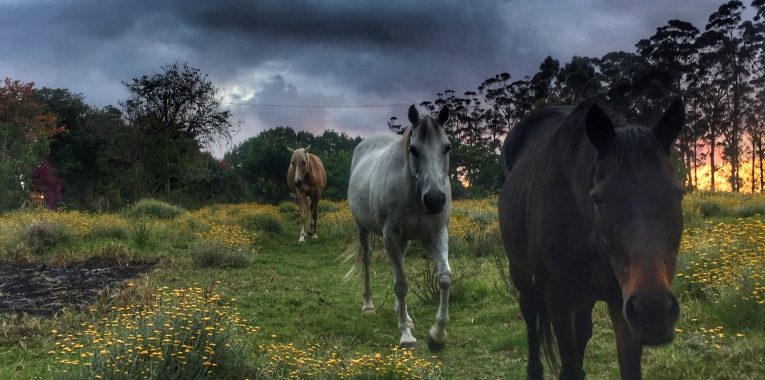
The first time I met Norma Jean, I sang her Candle in the Wind.* After that, I sang it to her most meal times – which, for a horse is roughly twice a day, although they actually eat all the time. They have to, for their digestive system to work properly. That’s why horses do best when there is plenty of grazing. A horse with its head down eating is relaxed and content. And the stomach acid in the hind gut has something to work on all the time, which helps prevent ulcers.
When I met her eight years ago, Norma Jean was thin and ribby and old. We didn’t know how old. She was here, on the farm, living out her life, neglected to be sure, but there is generally enough grazing here to keep a horse (or four) going all right. Unless they are a thoroughbred, like Norma Jean, and of uncertain – but significant – age. Then they need supplementation. The first thing I did when I bought the farm – even before I moved here – was to I start feeding Norma Jean Golden Years, which as the name suggests is for older horses. Within a year I was living here and singing her the song as I dished out her food.
Mealtimes became a dance because Astro, the other equine who came with the farm, wanted in on the high-calory molassesy goodness – but she’s not allowed to have any.
Astro is what they call a ‘grey’, which means she is a glowing white horse. There was a picture of her on the estate agent’s flier advertising the farm for sale, and that probably clinched the deal. Astro is a unicorn, stocky and small – more of a pony, really, but with a presence. She was born on this farm in 2000 (which makes her 25 this year), and she owns it.
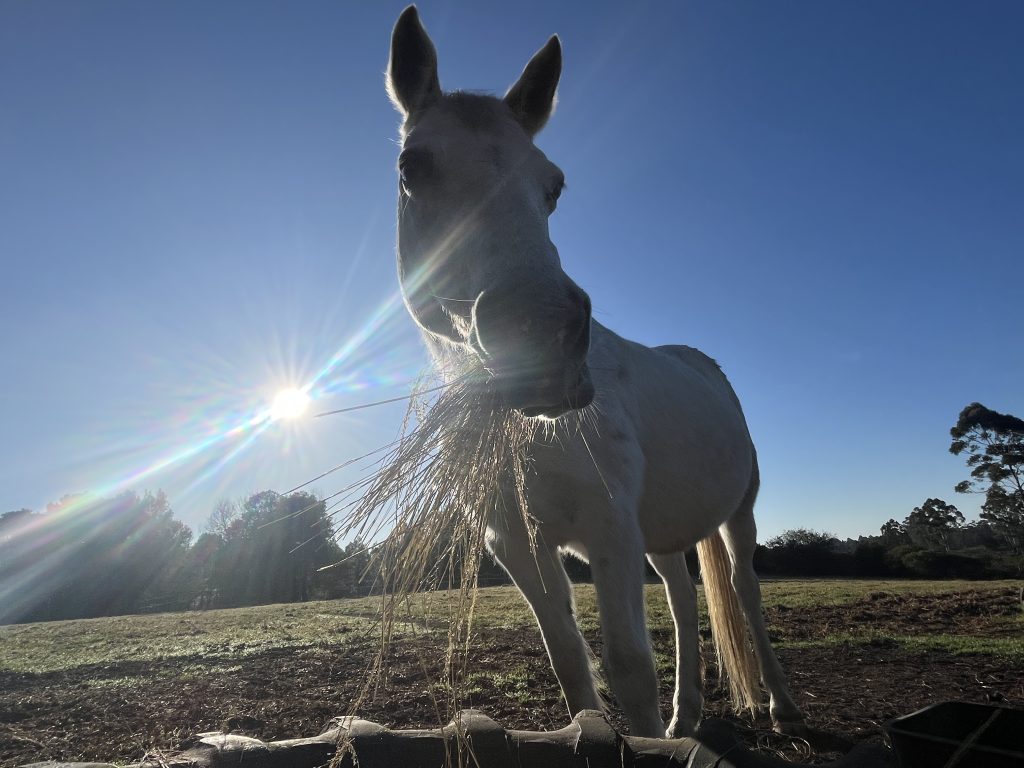
She’s probably known Norma Jean all her life.
But unlike Norma Jean, she doesn’t need any supplementation. Even on grass rations, Astro is on the dangerously portly side. Being overweight is not a good thing for horses. (Look up laminitis if you don’t know why.) Which is why meal times became a dance of distraction and deflection and required all the natural horsemanship persuasion and big-bubble-space skills to keep Astro away from Norma Jean’s food.
Within a month of moving here I brought my golden girl Shakira up from Cape Town to join the herd which spread out the distraction dance a bit. The three of them bonded. They became the three amigas.
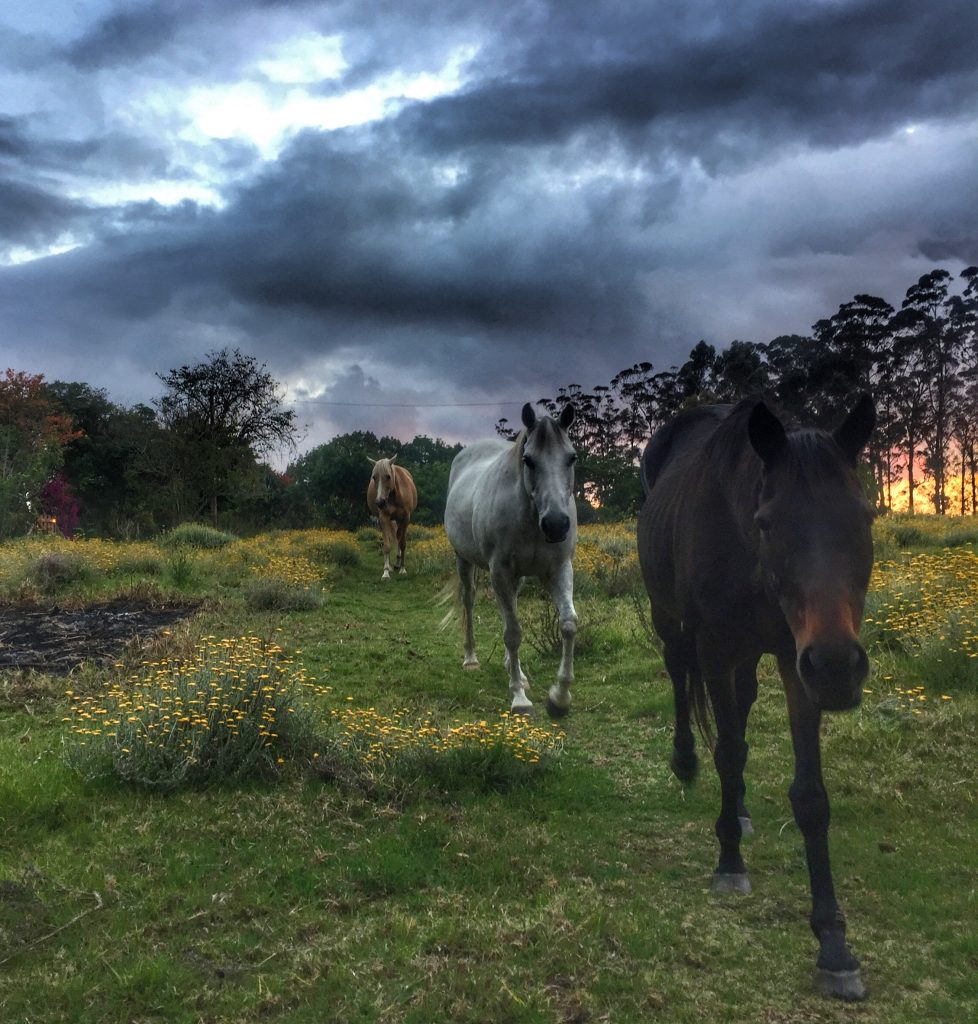
When Felix the stud joined a couple of years later, the herd was solid. Astro and NJ were pretty much inseparable, Shakira would sometimes hang out with them, sometimes with Felix, who sometimes needed his own space. (As a former stallion, he’d got used to it.)
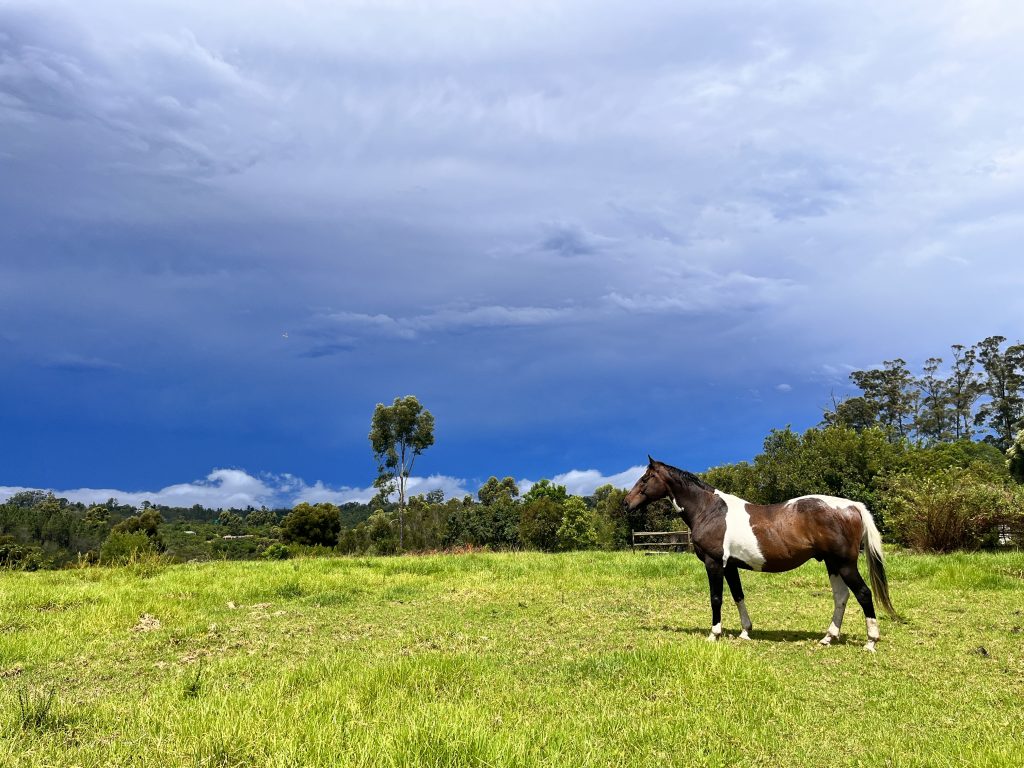
Most of the time they all hung out together.
My favourite thing is when they come walking past my cabin in single file in the evenings, on their way from one side of the farm to the other. One of them will give a snort so I know they are there, and so I can bring out a carrot or apple core if I have one handy. They generally let me know they are coming past, even in the early hours. On moonlit nights I go out and find them wherever they are on the farm and just stand with them under the stars. I take pictures of them without a flash that come out looking like daylight with long exposure.
Horses at night are the most calming thing there is.
On this farm I practice ‘paradise pasturing’. Which effectively means that the horses are free range, and can go where they like, when they like. There is a home base where they get fed and their permanent water trough is, as well as a walk-in stable shelter to get out of the wind or rain. From that central base they can choose which of the four pastures they want to graze in. They don’t get locked in at night; they wander and graze and pretty much have the life of Larry, only asked to submit to being lunged or ridden a few times a week to keep them fit and supple.
Norma Jean and Astro were excused from even this mild work detail. Astro has never had a saddle on her, I was told by the previous farm owner. As for Norma Jean … well, there are stories about Norma Jean.
I was told that she once ran in the Durban July (South Africa’s premiere horse race). That she had a few foals (which is often the case when a good mare comes off the track), that she came to the Crags to be a polo horse but wasn’t suited to that. What I do know for sure is that she was head shy at first – she did not like being touched anywhere on her face, distrusted a halter and would duck out and away if you approached her with one. I always wondered what had happened to make her so.
In the last weeks of her life though, she would nicker and lean in to me for a head scratch between ears that were so furry with winter coat fluff she looked like a well-worn teddy bear. The hair on her legs had become crazy long too. The hair on her body not so much, because this year I found her an intense deep-purple weather-proof winter jacket which she wore all through winter, except on unusually warm and sunny days. She was feeling the cold.


Three years ago my local vet told me Norma Jean wouldn’t – or shouldn’t -– live through another winter. But that was around the time I got Felix (the stud!) and all the girls – and especially Norma Jean – were feeling frisky around the new arrival. She’ll let me know when she’s ready to go, I reasoned.
This last week, she finally did.
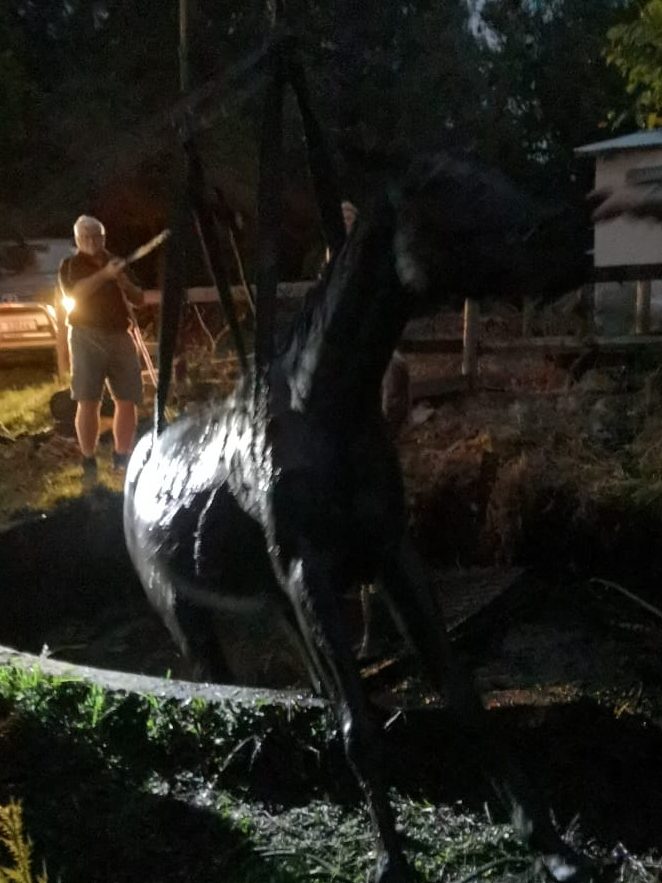
It’s not as if her life in the time I knew her here lacked adventure. There was the time she walked right into the sunken concrete reservoir tank behind the studio. It was in my first year here, and it didn’t have a fence around it at the time. I’d reckoned the horses that had been living here for a time must be aware of any hazards. A dangerous assumption.
I wasn’t actually on the farm at the time; I was recovering from a knee replacement in Cape Town and counting the days and the leg lifts until I was strong enough to drive a car and get back here. But my father was here (pushing ninety-years-old himself, and not so sharp with the eyesight either). He heard the horses distress calling and found his way to the reservoir where Norma Jean was paddling around in the middle unable to get out.
A concrete reservoir is a round shape and has no slope or steps. I can only assume that, because of a wet rainy season, the water level was flush with the ground and Norma Jean, being of forgetful mind or failing sight or both, had assumed she could walk right into or over it.
Now there was a horse in a tank, and I was on a sofa in Cape Town, high on pain meds, feeling useless and ineffectual in an emergency.
There the times on a farm when your friends and neighbours are your saviours and this proved to be one of them. Luckily, there were a few people on the farm building things, so my father didn’t have to do much after sounding the alarm. He did do me the favour of phoning again to tell me people were mobilizing, and then failing to disconnect the call (even though he thought he had – 90!).
So I was in his pocket for the next hour and a half hearing people shouting and getting wet and being kicked as they tried and failed to pull Norma Jean out, and tractors arriving and authoritative voices giving instructions and heads being scratched (figuratively of course because – well, that’s not going to come over on a pocket call) and eventually a hammock was slung under a by-now-dangerously-tired Norma Jean, and she was crane-lifted out of the water to be towelled off and given TLC by the attendant vet. By the time I got back to the farm three weeks later, she was back to her normal self.
Goodbye Norma Jean / Though I never
knew you at all / you had the grace to hold yourself
while those around you crawled
It might seem to onlookers that Norma Jean held herself aloof and apart but she was also the glue that held the herd together. Because she was the oldest, and increasingly the frailest, everyone had to slow down to her pace because – like in all the best comrade stories, in a herd no one gets left behind.
The herd mind is a beautiful thing to behold. A herd is a unit, made up of a number of individuals. If you take the time to observe them while they graze (under a full moon, or on any given day) you will see how they match their stance and their steps. Without raising their heads to look at one another, they sense the shift of weight and movement.
One of the first principles of natural horsemanship is to match steps with your horse. It requires a surprising amount of patience, of letting go of expectation. You can’t hurry this kind of love.
Norma Jean’s last night was the night after the blood moon eclipse on the 7 September. I was glad she got to experience that eclipse. I wonder what it was like for the herd, having the full moon blink out slowly and then return. I wasn’t with them, I was watching it from the balcony of a friend’s house overlooking Keurboom’s Beach.
But that next night the moon as still bright enough to walk through the fields without a torch. It even lit up the intense purple of Norma Jean’s jacket. I took a container of apple, chopped up small so that she could chew them even with her worn and abscessed tooth.
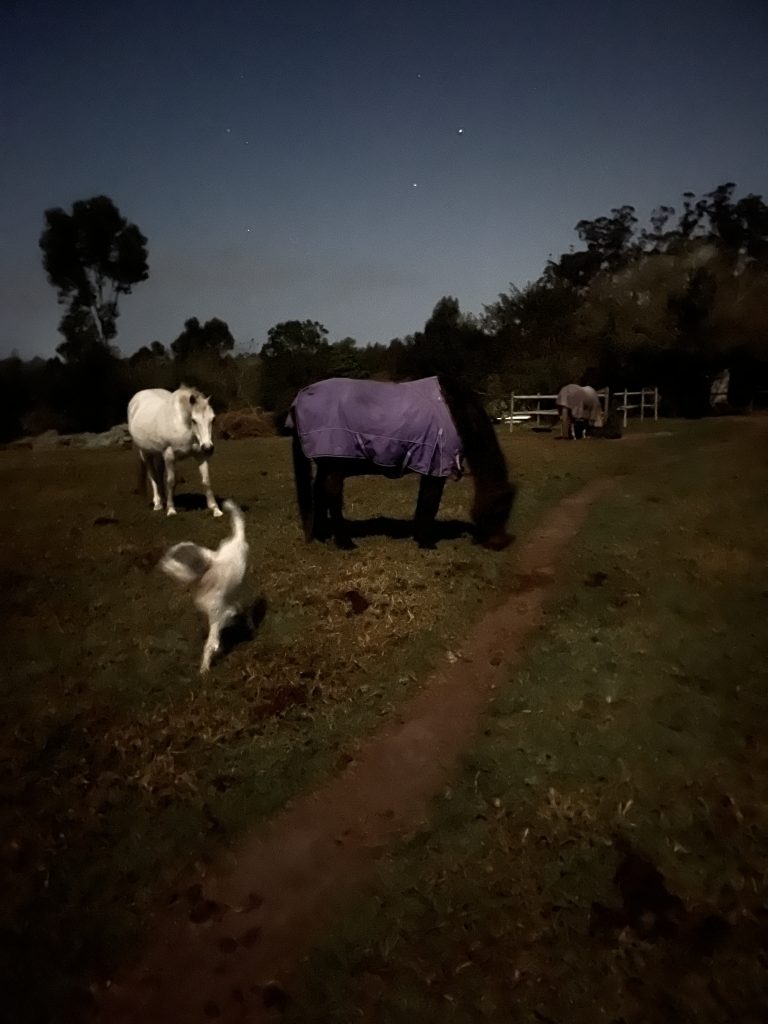
The pus that had started coming from her nose days before was stomach-gagging putrid, and one of the things that convinced me it was her time; invasive surgeries and weeks of antibiotics would have put too much strain on a system that was already suffering from metabolic shut down. But she still had an appetite for apple, and I fed them to her from the palm of my hand, not even minding the smell, as I crooned to her and scratched the mound between her furry ears. My sweet and gentle girl. I may not have chosen her as I’ve chosen other horses, but she came to me with a farm that has proved to be the greatest gift.
Now that she is gone I realise how much she made it so.
Don’t it always seem to go, that you don’t know what you’ve got till it’s gone.
The herd holds the farm. Their presence, their timed perambulations, their soft snorts, their occasional mad gallops just before a hail storm when they dash for shelter before any of us suspect that ice stones are about to fall from the sky. How do they know these things?
And how did they know the very second Norma Jean was gone?
Astro, Shakira and Felix were all on one side of the farm, at the home base.
Norma Jean, the vet and I were way over on the other side of the farm, near the far border where my neighbour had kindly agreed to come over with a TLB later and dig her grave. I’d spent the previous evening walking and scoping and had chosen this place.
First there was a sedative. And more apples. Then the euthanizing injection. Stand back, Magda the vet says. It will reach the brain quickly and she will fall. (Even in her ancient and withered state she would have weighed over 200 kg.)
I stood back.
Norma Jean won’t feel a thing, she said. But the herd did.
If I had any doubt as to the integrity of the cosmic field (I do not) or the connectedness and sensitivity of the herd (ditto), what happened next proved it.
The very moment that Norma Jean fell, all three horses took off from the other side of the farm. I heard their hooves pounding and saw the dust cloud approaching (we’re currently in a drought). As one, Felix, Shakira and Astro thundered past, wheeled around at the farm’s main gate, and swept past again to head back where they’d come from. It was as if they were scooping up Norma Jean’s spirit and taking it on one last joy run before it left this Earthly plane.
Things are being born into and leaving this world all the time. But when it’s a soul you have known and cared for and come to love, you feel the lack. The horses are mourning, in their quiet way. I make sure to give Astro extra love, and apples.
We have made a beautiful grave for NJ. This week I will plant it with succulents and flowers. And I’m thinking at least one September Bush.
Run free Norma Jean. Run free.
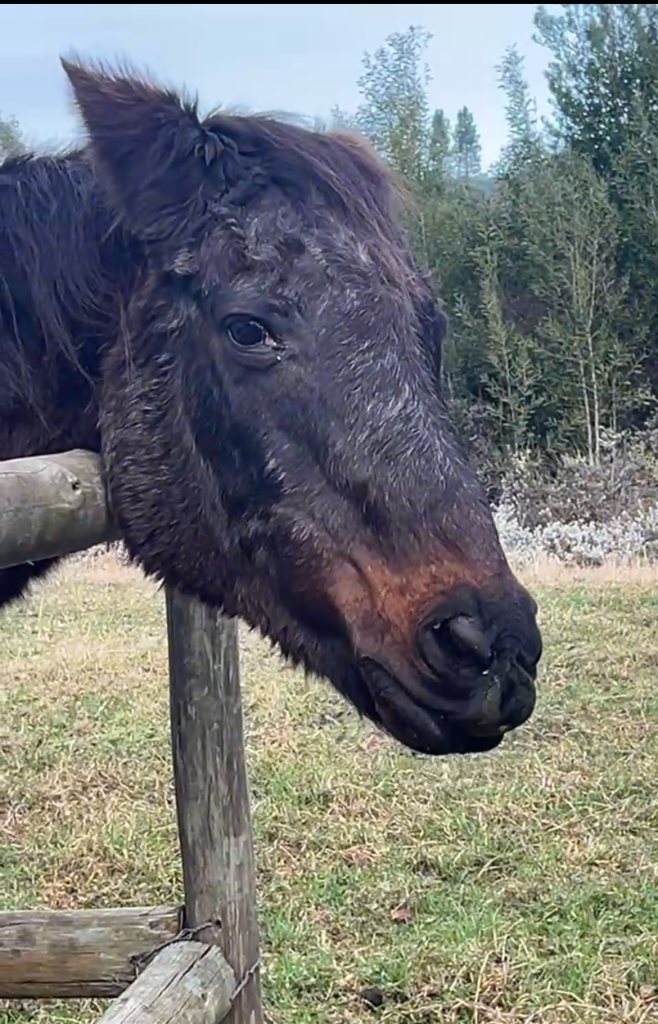
RIP Norma Jean 9/9/2025 <3
* (The original version, which Elton John wrote for Marilyn Monroe, not the reworked one after the passing of Princess Di.)